
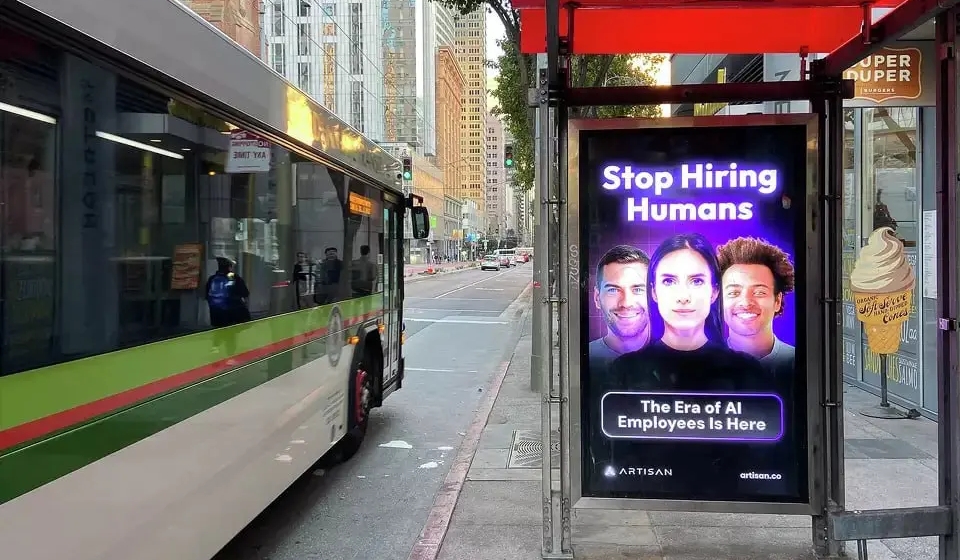
In recent months, a provocative marketing campaign has taken the U.S. by storm, prompting many to contemplate the escalating topic of AI job replacement. Billboards across major cities boldly proclaim, “Stop Hiring Humans,” inviting both intrigue and outrage. The campaign, initiated by Artisan AI, a San Francisco-based startup, aims to promote their virtual employees, like the AI-powered sales assistant named Ava. As awareness around automation grows, curious observers are left wondering how advancements in artificial intelligence will reshape our workforce.
Understanding AI Job Replacement
The term AI job replacement increasingly resonates as businesses explore automation solutions. Some skeptics question whether AI can truly replace the human touch. However, numerous studies indicate that a significant portion of jobs could soon be at risk. In 2021, the McKinsey Global Institute estimated that up to 800 million jobs will be displaced by automation worldwide by 2030. This staggering statistic reflects growing concerns about labor market stability and economic inequality as robots and AI systems take on tasks traditionally performed by humans.
Businesses are incentivized to adopt AI technologies for their efficiency and cost-saving potential. Tasks that require repetitive actions or data analysis are prime candidates for AI job replacement. Employees may find themselves displaced as machines become capable of performing these functions with greater accuracy and speed. This shift necessitates a conversation about reskilling the workforce and creating new opportunities for laborers displaced by automation.
Automation’s Impact on Various Sectors
Industries from manufacturing to healthcare are not immune to the wave of AI job replacement. Companies employing advanced technology in their operations can streamline processes and increase profitability. For example, in the automotive sector, manufacturers are now utilizing robots on assembly lines, which has reduced production costs significantly. This is a striking example of how emerging technology is rendering certain roles obsolete, yet also highlighting the importance of adaptability and innovation in new job creation.
Furthermore, the healthcare sector is witnessing a transformation as AI-driven applications assist health professionals in diagnosing conditions and personalizing treatment programs. As outlined in our article on how AI in healthcare demands policy reform for innovation boost, this trend could lead to many traditional caregiving roles being replaced or redefined.
The Repercussions of AI Job Replacement
While automation offers numerous advantages, the repercussions of AI job replacement extend beyond mere job loss. The backlash against Artisan AI’s billboard campaign signifies a growing public fear regarding the future milieu of work. As seen on social media platforms, posts expressing outrage reflect anxiety over individuals being left behind as businesses increasingly turn to machines.
U.S. Senator Bernie Sanders voiced concerns about the implications on displaced workers, stating, “How will those displaced workers survive when there are no jobs or income for them?” This highlights the necessity of creating a safety net for those affected and ensuring that socioeconomic equality remains a priority in the discussion surrounding AI job replacement.
Embracing Collaboration Between AI and Humans
Despite the looming threats giant tech companies present, there lies potential in a cooperative future. Organizations can prioritize AI job replacement as an opportunity to focus on creative problem-solving and innovation. Many experts advocate for a model where human workers and AI collaborate instead of one completely replacing the other. Merging human intuition with machine intelligence can lead to remarkable breakthroughs, fostering a workplace that enhances productivity and job satisfaction.
For starters, reskilling with AI job replacement in mind is crucial. Employees should be encouraged to learn new digital skills and engage in ongoing education. As examined in our article on AI work visas revolutionizes work for the better, adapting to new technologies will empower workforce sustainability and economic growth, as well as minimize the adverse effects of job displacement.
Concluding Thoughts on the Future of Work
As we navigate the ongoing discourse surrounding AI job replacement, it’s essential to embrace an optimistic view of the future. The world of work is evolving, and society must adapt accordingly. By engaging in robust conversations regarding the implementation of AI technologies in business processes, we can ensure that displaced workers have access to opportunities and retraining.
Artisan AI’s bold marketing may have raised eyebrows, but it serves as a clarion call for industries to thoughtfully confront the implications of automation. Getting people to talk about the future of work, aspects of both collaboration and replacement, is the first step toward creating pathways for human advancement alongside machine efficiency. To deepen this topic, check our detailed analyses on Tech Startups section.
To deepen this topic, check our detailed analyses on Tech Startups section



