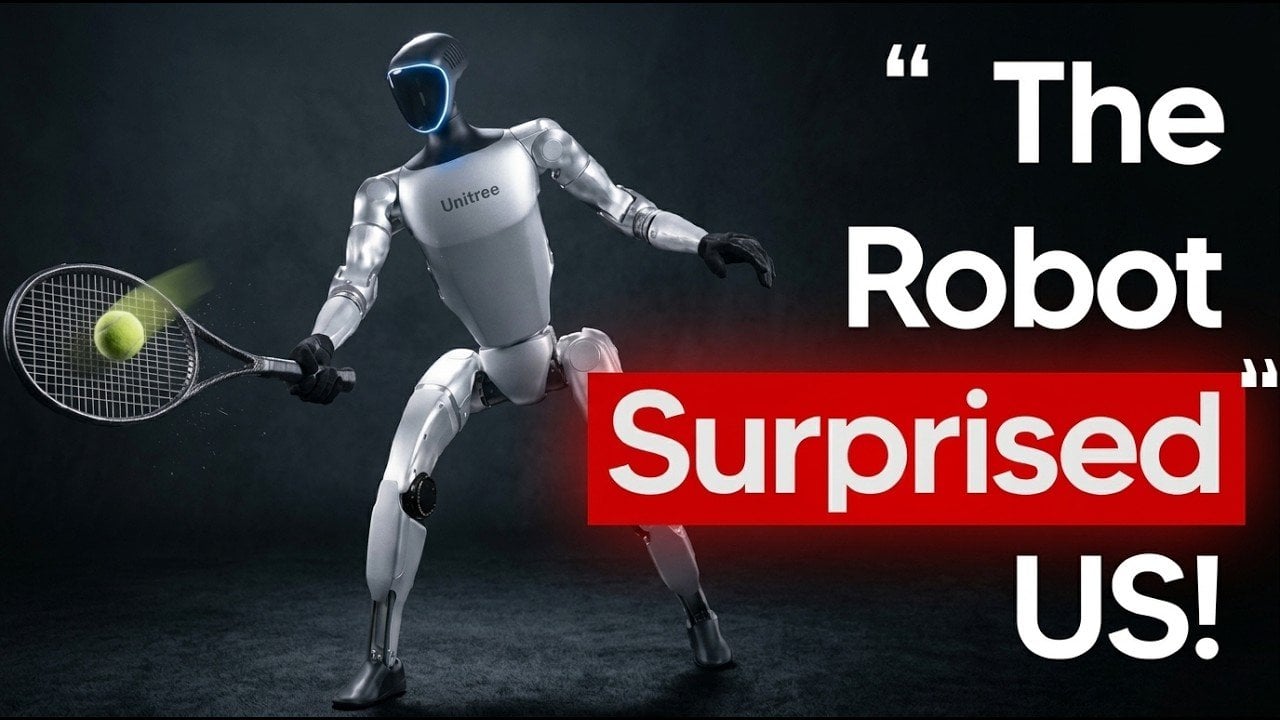
Imagine a world where robots not only assist us but play sports, showcasing incredible agility and precision. The emergence of humanoid robot tennis is not just a fascinating spectacle; it represents a significant leap in robotics and artificial intelligence. Recently, researchers introduced the Unitree G1, a humanoid robot specifically designed to tackle the challenges of tennis. Standing at 127 cm tall and featuring 29 degrees of freedom, the Unitree G1 employs an advanced AI system known as “Latent,” which learned from just five hours of motion capture data. This innovative approach enables the robot to mimic human-like movements, exemplifying how AI and robotics can converge to perform complex physical tasks. Explore how the Unitree G1 is setting benchmarks in sports robotics while laundering towards applications beyond tennis.
Unitree G1: A Breakthrough in Humanoid Robotics
With its state-of-the-art mechanics and design, the Unitree G1 is pushing the limits of what humanoid robots can achieve. Its 3D-printed connector allows for secure handling of a full-sized tennis racket, essential for executing intricate strokes. By integrating advanced mechanics, the robot achieves remarkable precision in a sport where even slight miscalculations can lead to failure. A striking statistic reveals that the Unitree G1 maintains an impressive 91% success rate for forehand strokes and a 78% success rate for backhand strokes during practice matches. This performance indicates not only the technological prowess of the robot but also its potential applications across various domains. Learn more about the capabilities of robotics in sports and industries similar to strategies discussed in our latest analysis on hybrid robotics.
Challenges of Playing Tennis with Robotics
Despite its capabilities, playing tennis is a demanding task for robots due to the sport’s fast-paced nature and unpredictability. Key challenges faced by humanoid robots in this domain include:
- Tracking tennis balls traveling at speeds up to 30 meters per second with high accuracy.
- Coordinating full-body movements for effective execution of strokes.
- Making split-second decisions in response to the dynamic nature of gameplay.
These challenges enhance the importance of incorporating real-time decision-making and advanced sensor integration into robotic designs. By overcoming these hurdles, robotics can take on more complex tasks, making tennis an ideal avenue for testing and evolving humanoid capabilities. Additional information about robotics in other fast-paced environments can be found in our insights on future technology.
The Role of AI in Developing Tennis Skills
The AI system, “Latent”, is groundbreaking in its ability to train using imperfect motion capture data. Unlike traditional models needing extensive datasets, Latent achieved proficiency through just five hours of data from amateur players. This innovative training allows the robot to translate human movements into robotic actions effectively. The adaptability of the Unitree G1 to execute complex strokes highlights the potential for AI to bridge the gap between human capabilities and robotic execution. As explored in our analysis of AI in predictive models, this technology demonstrates potential applications across a wide range of fields.
From Simulation to Real-World Competence
Training commenced in a virtual environment to simulate unpredictable conditions. The results are impressive, with the Unitree G1 achieving high success rates during practical tests. The integration of simulated training environments allows the robot to overcome real-world obstacles, paving the way for applications in various sectors. For instance, its capability to learn from limited and low-cost data signifies a shift towards more efficient robotic training processes applicable to multiple tasks. Innovations in robotics can signify a transition from theory to practical applications, as mentioned in our review of emerging biotechnologies.
Expanding Horizons for Humanoid Robotics
The future seems bright for humanoid robots. Researchers are focusing on enhancing autonomy and operational capabilities by equipping robots with onboard cameras and sensors. This upgrade would diminish reliance on external tracking systems, allowing for more spontaneous and independent functions. Additionally, future investigations may explore multi-agent scenarios, enabling robots to engage in cooperative tasks, such as doubles tennis. With this core advancement in humanoid robotics, the potential reaches far beyond sports and could revolutionize various industries, providing solutions in fields like healthcare and disaster response.
To deepen this topic, check our detailed analyses on Gadgets & Devices section.