In the fast-paced world of technology, Uber MySQL uptime has emerged as a critical metric, reflecting the reliability of data management systems. In a surprising turn of events, Uber has redefined its MySQL infrastructure to enhance cluster uptime, replacing external failover methods with an innovative solution—MySQL Group Replication (MGR). This significant shift aims to reduce downtime from minutes to mere seconds while maintaining robust consistency across thousands of clusters. For tech enthusiasts and businesses alike, understanding the intricacies of Uber MySQL uptime offers valuable insights into maintaining operational reliability and responsiveness.
Transforming Reliability with MySQL Group Replication
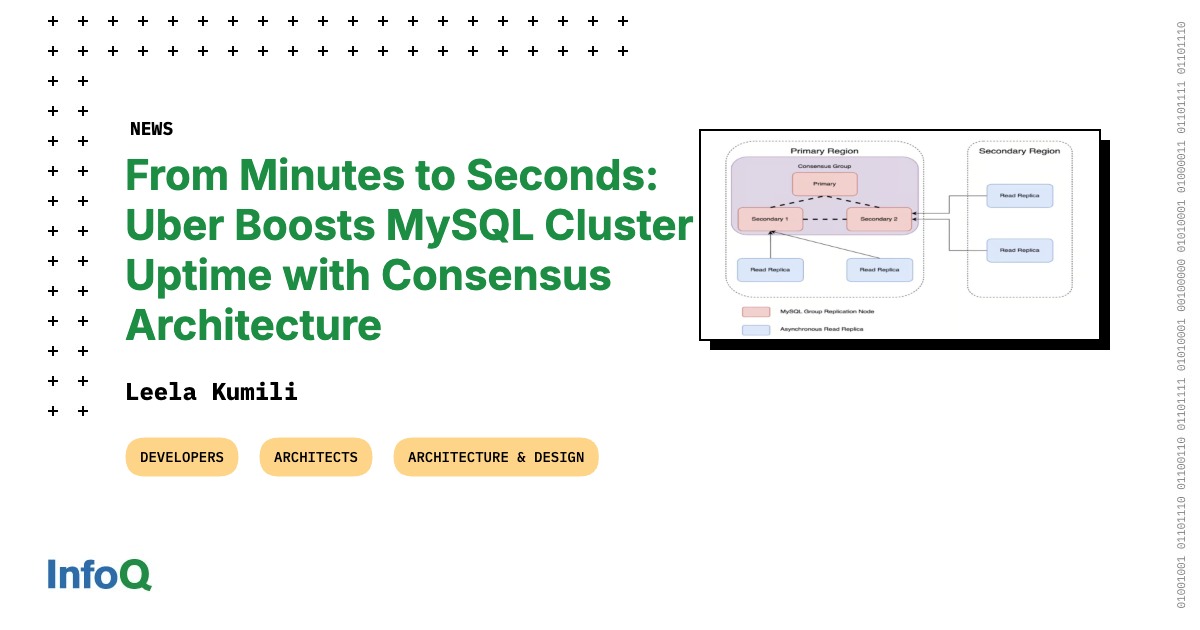
Uber’s major redesign began by integrating consensus replication, effectively removing external dependencies that previously caused long failover times. The company transitioned from a single-primary, asynchronous replica model to a more effective consensus-based approach. This groundbreaking architecture not only enhances MySQL uptime but also ensures that all nodes within the system maintain up-to-date data.
In this new architecture, a three-node MGR cluster is formed where:
- One node acts as the primary for write operations.
- The remaining two nodes serve as secondaries, participating in consensus but not accepting direct writes, which reduces the chances of data inconsistencies.
The incorporation of MySQL Group Replication— a Paxos-based consensus protocol— ensures that a new primary can be elected automatically if needed, significantly enhancing uptime and reliability. As Uber Engineering stated, high availability is considered non-negotiable within their operations.
Benefits of Automated Failover and Load Distribution
By implementing automated failover mechanisms within MGR, Uber has seen a remarkable reduction in downtime. Traditionally, failover times stretched into minutes while external systems identified failures and promoted replicas. Under the new system, the failover can take less than 10 seconds, including the primary election and routing updates.
Central to this improvement is the robust architecture of the MGR solution:
- Flow control mechanisms monitor transaction queues on each secondary, signaling the primary to pause or adjust write operations to prevent nodes from lagging.
- This proactive approach mitigates replication inconsistencies, especially during failovers.
Additionally, scalable read replicas have been developed to fan out from secondaries, greatly enhancing read availability without compromising write consistency. This effective separation of read scaling from write availability bolsters Uber’s operational efficiency.
Challenges and Performance Trade-offs
Despite the numerous advantages, transitioning to a consensus-based architecture has presented its own challenges. Benchmarking results indicate a slight increase in write latency—roughly a few hundred microseconds—when compared to asynchronous replication. Nevertheless, this minor trade-off is vastly outweighed by a massive decrease in total write unavailability during primary failures.
Indeed, what used to be measured in minutes has been reduced to under 10 seconds, illustrating the substantial improvements in Uber MySQL uptime.
The combination of consensus-based replication, as well as automated workflows, has enabled increased levels of operational reliability. Notably, the new structure fosters a more manageable environment, with workflows to handle both graceful and ungraceful node replacements, safeguarding against split-brain scenarios and maintaining overall system stability.
Automated Topology Management and Health Analysis
Uber’s ability to scale its MySQL architecture hinges on an automated control plane that oversees tasks such as cluster onboarding, offboarding to legacy systems, and rebalancing during topology changes. This automation allows for greater agility and ensures that Uber can dynamically add or remove nodes as needed.
Moreover, health analysis tools monitor cluster dynamics, ensuring that the system achieves quorum and reduces operational overhead. These innovations are crucial for maintaining high availability and strong consistency across the board.
The robust frameworks implemented within Uber’s MySQL infrastructure serve as a prime example of how technology can ensure reliability in high-stakes environments, reflecting a commitment to innovation and excellence.
Conclusion
The advancements in Uber MySQL uptime not only set a benchmark for the tech industry but also highlight the importance of error minimization and operational resilience. As businesses increasingly rely on data-driven strategies, Uber’s innovative approach to MySQL cluster management serves as a testament to what can be achieved when cutting-edge technology and meticulous planning converge. If you’re intrigued by further applications and insights similar to strategies discussed in Uber’s technological advancements, explore our other analyses on AI in healthcare and crypto trading insights.
To deepen this topic, check our detailed analyses on Apps & Software section